
Why Uganda Is a Birding Hotspot. Ask any serious birder where to go for one of the best birding experiences on Earth, and Uganda will almost always come up. Despite being one of Africa’s smaller countries, Uganda punches far above its weight when it comes to bird diversity. Here’s why birders from all over the world keep coming back.
An Incredible Number of Species in a Small Space
Uganda is home to over 1,080 bird species — more than half of Africa’s total bird species, found within a country roughly the size of the UK.
Why this matters:
- You don’t need to travel huge distances to see a wide variety of birds
- Multiple habitats sit close together, so species diversity changes quickly as you move
- A two-week trip can realistically yield 400+ species on a well-planned route
Few countries in the world offer this much birding reward for the amount of ground you actually have to cover.
Uganda Sits at a Unique Geographic Crossroads
Uganda’s location is a major reason for its birdlife diversity. It sits where the East African savannah, the Central African rainforest, and the Albertine Rift highlands all meet.
This overlap brings together:
- Savannah species typical of East Africa
- Rainforest species typical of the Congo Basin
- Albertine Rift endemics found almost nowhere else on the planet
This mix means a single trip through Uganda can feel like visiting three very different birding regions at once.
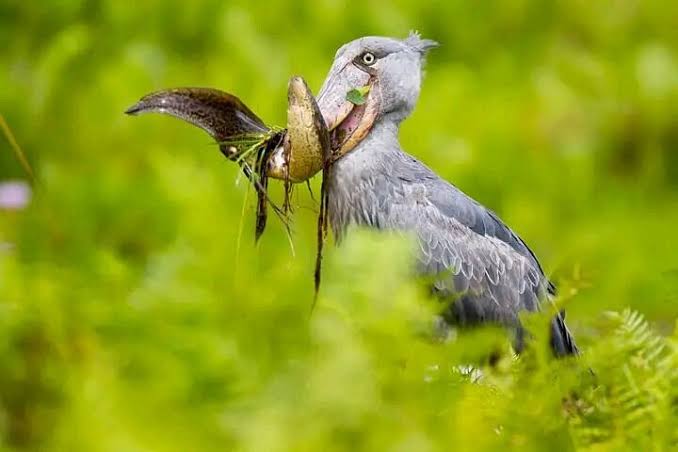
Home to the Legendary Shoebill
No bird symbolizes Uganda birding quite like the shoebill stork — a prehistoric-looking bird with a massive, shoe-shaped bill and a stare that birders describe as unforgettable.
Where to find it:
- Mabamba Swamp, a short boat ride from Entebbe
- Murchison Falls National Park’s delta area
- Semuliki Wildlife Reserve
The shoebill alone draws dedicated birders to Uganda every year, and sightings here are considered some of the most reliable in Africa.
Albertine Rift Endemics – Why Uganda Is a Birding Hotspot
The Albertine Rift region, which runs along Uganda’s western border, is one of the most important biodiversity zones in Africa. It’s home to numerous endemic bird species found nowhere else.
Key species and locations:
- Bwindi Impenetrable National Park — green-breasted pitta, African green broadbill
- Semuliki National Park — Congo-influenced species rare elsewhere in East Africa
- Ruwenzori Mountains — Rwenzori turaco and other high-altitude endemics
For birders working through their Africa checklist, Uganda is often the only realistic place to tick several of these species.
Diverse Habitats, All Within Reach – Why Uganda Is a Birding Hotspot
Uganda’s varied landscapes mean birders can move between dramatically different ecosystems in a matter of hours.
Habitat variety includes:
- Tropical rainforest (Kibale, Bwindi, Budongo)
- Open savannah (Murchison Falls, Queen Elizabeth)
- Wetlands and swamps (Mabamba, Lake Mburo)
- Montane forest (Rwenzori Mountains, Echuya Forest)
This range means a single itinerary can include forest specialists, savannah raptors, and wetland waders — all without long transfers between sites.
Year-Round Birding with Migratory Bonuses
Uganda’s location near the equator means stable weather and consistent birding conditions throughout the year.
Timing highlights:
- Resident species are visible year-round
- Palearctic migrants arrive between November and April, adding even more variety
- The dry seasons (December–February and June–August) offer the easiest access to remote sites
Unlike destinations with a narrow birding season, Uganda rewards visitors at almost any time of year.
A Country Built for Birders – Why Uganda Is a Birding Hotspot
Beyond the birds themselves, Uganda has developed strong birding infrastructure over the years — experienced local guides, established birding lodges, and well-documented routes through top sites like Bwindi, Queen Elizabeth, and Murchison Falls.
Combined with warm hospitality and relatively easy logistics, it’s no surprise that Uganda has earned its reputation as one of Africa’s premier birding destinations — a place where rainforest, savannah, wetland, and highland species all share the same small map.