

Kibale Forest National Park is Uganda’s premier chimpanzee trekking destination and one of Africa’s richest primate forests. With Lavish Safaris Uganda, we take you deep into Kibale’s rainforest to track wild chimpanzees while exploring a remarkable ecosystem of monkeys, forest elephants, birds, butterflies and ancient trees.
Located in western Uganda near Fort Portal, Kibale National Park protects approximately 795 square kilometres of forest, grassland and wetland habitats. The park became a national park in 1993 after previously being managed as a forest reserve.
Kibale is best known for its chimpanzees.
However, reducing this destination to chimpanzee trekking alone misses much of what makes it special.
The forest supports 13 species of non-human primates, including chimpanzees, red colobus monkeys, black-and-white colobus monkeys, L’Hoest’s monkeys, red-tailed monkeys, blue monkeys and grey-cheeked mangabeys.
We can also combine your chimpanzee experience with birding, forest walks, Bigodi Wetland Sanctuary, cultural experiences and a wider western Uganda safari.
If you want to experience Uganda’s rainforest and meet chimpanzees in their natural habitat, Kibale belongs on your itinerary.
Kibale Forest National Park is worth visiting because it combines exceptional chimpanzee trekking with one of East Africa’s highest concentrations of primates, rich birdlife, rainforest scenery and community-based experiences. It also connects naturally with Queen Elizabeth National Park and the Rwenzori region.
We recommend Kibale for travellers who want a more intimate wildlife experience than a traditional savanna safari.
Here, the forest becomes the safari.
Instead of scanning open plains for elephants and lions, you listen for chimpanzee calls overhead. You follow fresh tracks through damp forest trails. You watch monkeys move through the canopy and learn how plants, insects, birds and mammals interact.
A Kibale safari can include:
The result is a very different kind of Ugandan safari.
| Feature | Kibale Forest National Park |
| Location | Western Uganda |
| Nearest major town | Fort Portal |
| Approximate area | 795 km² |
| Established as national park | 1993 |
| Main attraction | Chimpanzee trekking |
| Primate diversity | 13 recorded species |
| Chimpanzees | Large, habituated communities |
| Forest type | Moist tropical forest |
| Birdlife | 370+ species documented in park sources |
| Famous nearby attraction | Bigodi Wetland Sanctuary |
| Main chimpanzee tracking sector | Kanyanchu |
| Ideal safari duration | 2–3 nights |
| Best combinations | Queen Elizabeth, Semuliki, Bwindi, Rwenzori |
UWA’s General Management Plan identifies Kibale as approximately 795 km² and records 13 non-human primate species. Current UWA environmental documentation places the park’s documented bird richness at more than 370 species.
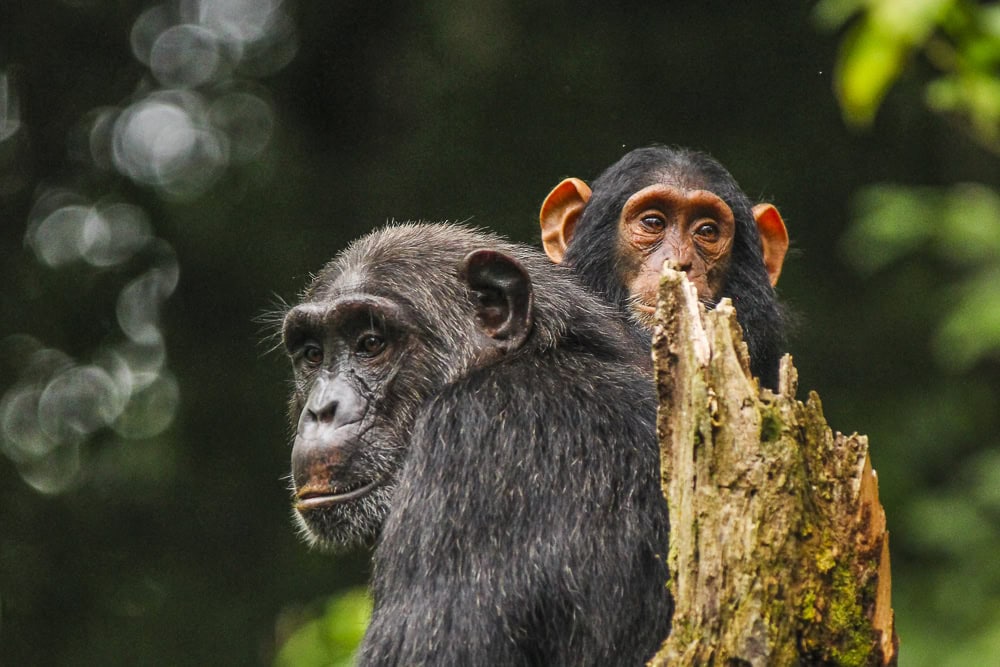
Chimpanzee trekking is Kibale Forest National Park’s signature experience. You walk through the rainforest with trained guides while searching for habituated chimpanzee communities, then spend a regulated period observing them when you find the group.
This is not a zoo visit. The chimpanzees remain wild. They move through the forest according to their own routines, feeding, travelling, calling, grooming and interacting with one another.
Our guides help you understand the signs that reveal where the chimpanzees may be. You may hear distant pant-hoots before seeing anything. Then suddenly, the forest changes.
Your experience generally follows this sequence:
UWA guidelines state that chimpanzee tracking begins at 8:00 am for morning tracking and 2:00 pm for afternoon tracking, while normal chimpanzee viewing is limited to a maximum of one hour once the animals are located.
The total trek varies because chimpanzees move freely through the forest. Some groups may be located relatively quickly.
Others may require a longer walk. We therefore recommend allowing several hours rather than planning another fixed activity immediately afterward.
Chimpanzee sightings in Kibale are generally very good because the park protects habituated communities, but no responsible safari company should guarantee a wildlife sighting. Chimpanzees remain wild animals and can move beyond your immediate trail.
This distinction is important.
Some tourism websites advertise very high or near-guaranteed sighting rates.
We prefer a more honest approach. Kibale is one of the strongest places in Uganda for chimpanzee trekking, and UWA has long-running habituated communities at Kanyanchu. However, wildlife behaviour remains unpredictable.
That means your experience depends partly on:
The reward is a genuinely wild encounter rather than a staged wildlife performance.
The chimpanzee habituation experience is designed for travellers who want substantially more time with chimpanzees than a normal trek. Instead of the standard one-hour viewing limit, the habituation experience can provide up to four hours of chimpanzee observation under UWA guidelines.
The experience starts early.
You may follow chimpanzees from their night nests as they begin their day.
You can observe:
The experience requires more patience than ordinary trekking.
It is particularly suitable for:
UWA currently identifies chimpanzee habituation as an all-day experience, while its guidelines specify a maximum four-hour viewing period for habituation.
Kibale is famous for chimpanzees, but its primate story goes much further. UWA’s management plan identifies 13 non-human primate species in the park, representing a remarkable concentration of primate diversity.
Depending on the area and conditions, you may encounter:
Not every species is equally easy to see. Some remain high in the canopy. Others move quietly through dense vegetation.
This makes Kibale particularly rewarding for travellers who enjoy careful observation.
Kibale provides important habitat for the red colobus monkey, one of the park’s most significant primate species. The species is among the threatened primates associated with Kibale and forms part of the park’s exceptional conservation value.
Red colobus monkeys can be difficult to photograph because they often remain within the canopy. Your guide can help identify them by movement, calls and feeding behaviour. For wildlife photographers, this is another reason to allow enough time in Kibale rather than rushing through on a single overnight stay.
Kibale is primarily a forest ecosystem, so wildlife viewing differs from the open savannas of Queen Elizabeth or Murchison Falls.
The park supports forest elephants, buffaloes, leopards and several species of antelope, although many larger mammals are more difficult to see within dense vegetation. UWA’s management documentation identifies elephant and leopard among the park’s threatened or near-threatened fauna.
You may encounter:
We set expectations carefully.
If your priority is large-game viewing, we recommend combining Kibale with Queen Elizabeth National Park. That gives you two completely different ecosystems in one itinerary.
Kibale is an excellent birding destination, with more than 370 bird species documented in park sources. Its forest canopy, wetlands, grasslands and surrounding habitats create opportunities for both specialist forest birds and more widespread species.
The forest is alive before you even see a bird. Calls move through the canopy. Leaves rustle above.
Birds cross narrow openings between trees. With a knowledgeable birding guide, you can search for species including:
The Bigodi Wetland Sanctuary adds another excellent birding environment close to Kibale.
Early morning is usually the most productive period because birds are more active and temperatures are cooler.
For serious birders, we can build dedicated birding walks into your itinerary rather than treating birding as a secondary activity.
Bigodi Wetland Sanctuary is a community-managed conservation area near Kibale and one of the best complementary experiences to add to a chimpanzee safari. It combines wetland biodiversity, birding, primate viewing and community tourism.
A guided walk takes you through wetland habitats and local landscapes.
Depending on conditions, you may encounter:
But the experience extends beyond wildlife. Community guides can introduce you to local traditions, medicinal plants, food production and livelihoods. Your visit therefore supports a tourism model where local communities directly participate in the visitor experience.
We recommend Bigodi when you want:
Chimpanzee trekking is not the only way to experience Kibale. Guided forest walks provide an opportunity to slow down and appreciate the smaller details of the ecosystem.
You can look for:
A forest walk is especially rewarding when you are travelling with someone who knows how to interpret the environment.
The rainforest can appear quiet at first.
Then your guide points out a distant call or movement you would otherwise have missed.
That is where local knowledge becomes valuable.
Kibale becomes a completely different ecosystem after sunset. Nocturnal forest experiences can reveal creatures that remain hidden during daytime trekking, including bush babies, chameleons, insects and other nocturnal wildlife.
A night experience is not simply a shorter version of a daytime walk. The atmosphere changes. Bird calls give way to insects and nocturnal sounds.
Your guide uses a torch to search carefully through vegetation while interpreting what you encounter. Because activities and availability can change, we recommend confirming the current authorised night-walk arrangements when booking.
Kibale’s appeal begins with the forest itself. The park protects a moist tropical forest ecosystem with additional grassland and wetland habitats.
The canopy creates a layered environment. Tall trees dominate above.
Vines and epiphytes occupy the middle levels.
The forest floor becomes a world of fallen leaves, roots, fungi and insects.
Streams and wetlands break up the forest. This complexity supports Kibale’s extraordinary biodiversity.
Scientific and conservation sources describe Kibale as one of East Africa’s important mid-altitude tropical forests and a major primate habitat.
Kibale Forest National Park is in western Uganda, near Fort Portal, approximately 20 kilometres southeast of Fort Portal city. Its location makes it particularly convenient to combine with Queen Elizabeth National Park, Semuliki National Park and other western Uganda destinations.
The park lies within the broader Albertine Rift landscape.
This location helps explain its ecological richness.
The region connects different habitats and elevations, creating conditions that support exceptional biodiversity.
The road journey from Kampala to Kibale takes several hours depending on the route, traffic, road conditions and stops.
We recommend treating the drive as part of the safari rather than simply a transfer.
The route passes through changing landscapes, towns, farms and tea-growing areas before reaching the greener western region.
Travellers arriving through Entebbe International Airport can begin their safari directly from the airport.
We can arrange a private vehicle and guide to meet you after arrival.
This is one of the easiest and most rewarding combinations.
After your chimpanzee experience in Kibale, we can drive south toward Queen Elizabeth National Park.
Along the way, the landscape changes from dense forest toward crater lakes and savanna.
Kibale and Bwindi can be combined, although the journey is longer.
We usually recommend placing another destination between them when your schedule allows.
Travellers seeking a more time-efficient luxury safari can use domestic or charter flights to an appropriate nearby airstrip before transferring by road.
We recommend confirming the most suitable airstrip based on your lodge and itinerary rather than choosing flights first.
Kibale Forest National Park is open for chimpanzee trekking throughout the year, but the best month depends on whether you prioritise trekking conditions, chimpanzee movements, photography, birding or lower-season travel. UWA specifically notes that chimpanzee tracking occurs year-round and that the rainy season can offer good tracking conditions despite muddy trails.
June to September
These months are generally popular because conditions are often drier.
Forest trails may be easier underfoot.
However, chimpanzees can move deeper into the forest in search of food.
December to February
This is another popular travel period.
Conditions are often relatively favourable for combining Kibale with other Ugandan destinations.
March to May
The long rains can make trails muddy.
However, the forest becomes intensely green.
For photographers, this can create beautiful atmospheric conditions.
September to November
The wetter period can bring lush vegetation and excellent forest scenery.
Birdwatching can also be rewarding.
So, what is the best month for chimpanzee trekking?
There is no single month that guarantees the best chimpanzee encounter.
UWA notes that chimpanzees may move deeper into the forest during drier periods, while the wetter season can offer better tracking conditions despite muddy trails.
We therefore plan around your complete safari rather than selling one season as universally perfect.
Kibale has a moist tropical climate, and rainfall can occur throughout the year. This is rainforest country.
A shower should not automatically be considered a bad safari day. Rain can make trails muddy, but it also refreshes the forest and creates beautiful photographic conditions.
For chimpanzee trekking, pack:
We recommend dressing for walking rather than dressing only for a conventional game drive.
Kibale safari costs depend on park entry, chimpanzee activities, accommodation, transport, guide services and other experiences. UWA sets official conservation and activity fees, which can change between tariff periods.
The UWA tariff covering July 2024 to June 2026 lists the following rates for Kibale:
| Activity | Foreign Non-Resident | Foreign Resident | East African Community |
| Park entrance | US$40 | US$30 | UGX 20,000 |
| Chimpanzee tracking | US$250 | US$200 | UGX 180,000 |
| Chimpanzee habituation | US$300 | US$250 | UGX 250,000 |
| Children’s guided short nature walk | US$5 | US$5 | UGX 10,000 |
The published tariff specifies these rates for the July 2024–June 2026 period.
Important: Fees are time-sensitive. We will confirm the applicable UWA tariff when preparing your safari quotation rather than relying on an outdated web price.
Your total safari price can include:
That is why there is no honest single price for a Kibale safari. We build your quotation around your actual itinerary.
Request Current Kibale Safari Pricing
We recommend at least two nights in Kibale for most travellers, giving you enough time for chimpanzee trekking and another forest or community experience without rushing.
Possible for travellers with limited time.
However, it leaves little flexibility.
Our preferred option for most first-time visitors.
You can include:
Ideal for:
For a deeper western Uganda journey, combine Kibale with:
Kibale → Queen Elizabeth → Bwindi or Kibale → Queen Elizabeth → Ishasha → Bwindi
They are one of our favourite combinations because they give you two dramatically different wildlife experiences.
Kibale is about:
Queen Elizabeth is about:
A combined safari lets you experience both ecosystems without travelling to completely different regions of Uganda.
Entebbe → Kibale → Queen Elizabeth → Bwindi → Lake Bunyonyi → Entebbe
This is particularly strong for international visitors who want both chimpanzees and gorillas.
If you want to experience Uganda’s great apes, combining Kibale chimpanzee trekking with Bwindi gorilla trekking creates one of East Africa’s most powerful primate journeys.
The experiences are different. Chimpanzees are more arboreal and highly mobile. Mountain gorillas live in high-altitude rainforest environments and offer a completely different trekking experience.
We can create a tailor-made itinerary around both.
For example:
Day 1: Entebbe arrival
Day 2: Transfer to Kibale
Day 3: Chimpanzee trekking
Day 4: Bigodi and transfer toward Queen Elizabeth
Day 5: Queen Elizabeth safari
Day 6: Transfer to Bwindi
Day 7: Gorilla trekking
Day 8: Lake Bunyonyi
Day 9: Return to Entebbe
We can extend the itinerary for luxury travellers who prefer slower travel.
Kibale can be excellent for families, but chimpanzee trekking requires a certain level of physical readiness.
We consider:
For younger children, we can explore alternative nature and community experiences.
Older children and teenagers often enjoy chimpanzee trekking because guides can turn the forest into an interactive wildlife classroom.
UWA also lists guided short nature walks for children among its Kibale activities.
Kibale may not be the first destination people associate with African honeymoons. We think it should be considered.
The forest provides privacy, atmosphere and a sense of adventure.
Imagine waking to forest sounds before heading out to search for chimpanzees. Later, you can return to your lodge, relax and enjoy the surrounding landscape.
We can combine Kibale with:
This creates a honeymoon that balances adventure with relaxation.
Kibale is particularly rewarding for photographers who enjoy intimate wildlife portraits, forest compositions, primate behaviour and atmospheric rainforest scenes.
Chimpanzee photography presents different challenges from savanna wildlife.
Light changes constantly under the canopy. Animals may be above you.
Branches can obstruct views. The forest can be dark even during daylight.
That makes patience essential.
We recommend:
If photography is your primary goal, tell us before booking.
We can design the itinerary around longer activity windows and suitable accommodation.
Kibale is not simply a tourist attraction. It is an important conservation landscape.
The park protects forest habitat for chimpanzees and numerous other species while supporting surrounding communities. Kibale also has a long history of ecological research and forest restoration.
In 2026, UWA highlighted restoration work within Kibale, including approximately 71.5 square kilometres of restored forest, with the restored landscape contributing to carbon absorption and local livelihoods.
That makes responsible tourism particularly important.
When we visit Kibale, we encourage guests to:
UWA’s chimpanzee management guidelines provide important safeguards for visitors, guides and wildlife. Normal chimpanzee viewing is limited to one hour, while habituation experiences can allow up to four hours.
Tracking takes place through designated entry points and with authorised guides. We also strongly recommend that anyone showing symptoms of an infectious illness does not participate in close primate encounters.
Chimpanzees are susceptible to several human diseases. Your responsible behaviour therefore protects both you and the animals.
Accommodation around Kibale ranges from comfortable mid-range lodges to luxury forest retreats.
We select your lodge based on:
For chimpanzee trekking, proximity to the activity starting point can matter more than having the most impressive lodge description.
A beautiful property farther away may add unnecessary driving. We therefore consider your complete route before recommending accommodation.
For luxury travellers, we can arrange premium accommodation and private transfers while keeping the itinerary relaxed.
Luxury, in our view, is not only about the room.
It is also about: privacy + time + service + location + flexibility.
A chimpanzee trek requires different preparation from a vehicle-based safari.
The forest can contain branches, vines and rough vegetation.
Simple gloves can make walking more comfortable.
We recommend choosing lightweight gloves that allow you to maintain good grip.
Kibale is a managed national park, and chimpanzee trekking takes place with trained guides under Uganda Wildlife Authority regulations. Visitors should follow their guide’s instructions at all times and avoid separating from the group.
Wild animals remain unpredictable. You should never approach chimpanzees independently.
You should also never attempt to touch wildlife. Our safari guides brief guests before activities and help ensure that the experience follows the applicable park rules.
| Kibale Forest | Queen Elizabeth |
| Tropical rainforest | Savanna and wetland ecosystems |
| Chimpanzees | Lions and elephants |
| 13 primate species | Diverse large mammals |
| Forest walks | Game drives |
| Bigodi Wetland | Kazinga Channel |
| Excellent for primates | Excellent for Big Game |
| Birding | Birding |
| Best for chimpanzee lovers | Best for classic safari lovers |
These parks are sometimes compared because both offer extraordinary primate experiences. But they are fundamentally different.
Kibale is Uganda’s leading chimpanzee trekking destination. Bwindi is one of the world’s premier mountain gorilla trekking destinations.
Kibale offers lower-elevation rainforest and extensive primate diversity. Bwindi involves steep, high-altitude rainforest trekking in search of mountain gorillas.
If your budget and time allow, combining them creates a spectacular great-ape safari.
We depart Entebbe or Kampala and travel west toward Fort Portal and Kibale.
The route introduces you to Uganda’s changing landscapes.
After arriving at your lodge, you can relax and prepare for the next day’s chimpanzee trek.
We begin with your chimpanzee tracking experience.
After the briefing, we enter the forest with our guides.
Once we locate the chimpanzee community, we observe their behaviour within the permitted viewing period.
Later, depending on your itinerary, we visit Bigodi Wetland Sanctuary.
We enjoy a final nature or cultural experience before continuing toward your next destination.
If you are combining Kibale with Queen Elizabeth, we can continue south toward the park.
If you are returning to Entebbe, we arrange your onward transfer according to your flight schedule.
<ul>
orest</li>
nctuary
ame drive
boat cruise
nward journey
This route is ideal for travellers who want both chimpanzees and classic African wildlife without making the itinerary excessively long.
We believe the best Uganda safaris should feel personal. You should not receive the same itinerary as everyone else.
When you travel with Lavish Safaris Uganda, we can tailor your experience around:
Travel privately and control your pace.
Our guides interpret wildlife, landscapes and local communities rather than simply driving between attractions.
We combine Kibale with the destinations that make sense for your interests.
Choose from suitable budget, mid-range and luxury accommodation.
We can combine Kibale with Bwindi for a complete great-ape experience.
Private transfers, premium accommodation and domestic flights can reduce unnecessary travel time.
We never promise a wildlife encounter that nature cannot guarantee.
That matters. A trustworthy safari company should tell you what is likely, what is possible and what remains unpredictable.

Kibale is most famous for chimpanzee trekking and its exceptional primate diversity. The park supports 13 recorded non-human primate species and is one of Uganda’s most important chimpanzee habitats.
Kibale is located in western Uganda, approximately 20 kilometres southeast of Fort Portal.
Kibale National Park covers approximately 795 square kilometres according to UWA’s General Management Plan.
Kibale supports a substantial chimpanzee population across several communities, but population estimates vary by survey and methodology. We recommend avoiding claims that imply an exact current population unless supported by a recent official census.
No responsible operator should guarantee a chimpanzee sighting. Kibale is one of Uganda’s leading chimpanzee destinations and has habituated communities, but chimpanzees remain wild and mobile.
The total experience varies depending on where the chimpanzees are located and how far the tracking group must walk. UWA regulates normal viewing to a maximum of one hour after the chimpanzees are located.
The UWA tariff covering July 2024–June 2026 lists chimpanzee tracking at US$250 for foreign non-residents. Because tariffs change, confirm the applicable rate for your travel date.
The UWA July 2024–June 2026 tariff lists the full-day chimpanzee habituation experience at US$300 for foreign non-residents.
UWA guidelines specify 8:00 am for morning chimpanzee tracking and 2:00 pm for afternoon tracking. Habituation begins at 6:30 am.
Chimpanzee trekking operates throughout the year. UWA notes that the rainy season can provide good tracking conditions, although trails may be muddy. During dry periods, chimpanzees can move deeper into the forest while searching for food.
Eligibility depends on current UWA rules and the child’s age. We recommend confirming the current minimum age before booking and can suggest suitable family alternatives when necessary.
Yes. Kibale and Queen Elizabeth make an excellent combination because Kibale provides chimpanzees and rainforest while Queen Elizabeth offers savanna wildlife and the Kazinga Channel.
Yes. Kibale can be combined with Bwindi or Mgahinga to create a multi-primate Uganda safari.
Yes. More than 370 bird species have been documented in park sources, making Kibale an important forest birding destination.
You can enjoy forest walks, birding, primate viewing, Bigodi Wetland Sanctuary, community experiences and other authorised nature activities.
No. Bigodi is a community-managed wetland sanctuary outside the national park. It is commonly visited as a complementary experience during Kibale safaris.
Absolutely, particularly if you want chimpanzees, primates and rainforest experiences. We recommend adding Queen Elizabeth or another savanna destination if you also want classic Big Game viewing.
Kibale is a place where the forest becomes your safari vehicle.
You meet communities living alongside one of Uganda’s most important forests. And when the chimpanzees finally appear, the experience feels earned.
We can design your Kibale Forest National Park safari around chimpanzee trekking, habituation, birding, photography, family travel, honeymoon experiences or a complete Uganda wildlife circuit.
Or slow down and experience Kibale on its own.
Tell us your travel dates, number of travellers and preferred accommodation level. We will create a personalised Uganda safari quotation for you.