

Queen Elizabeth National Park is one of Uganda’s finest wildlife safari destinations, combining classic game drives, the spectacular Kazinga Channel, chimpanzee tracking, tree-climbing lions, crater lakes, birding and dramatic Albertine Rift scenery. With Lavish Safaris Uganda, we tailor your visit around the wildlife, landscapes and experiences you want most.
Set between the Rwenzori Mountains and the western arm of Uganda’s Great Rift Valley, Queen Elizabeth National Park offers an exceptional variety of habitats within one destination. Open savanna supports elephants, buffaloes, Uganda kobs and predators, while wetlands, lakes and forests create opportunities for hippo viewing, birdwatching and primate encounters.
The park covers approximately 1,978 square kilometres and sits directly on the equator. It is one of Uganda’s oldest national parks and remains one of the country’s most diverse safari landscapes. UWA records more than 95 mammal species and over 600 bird species in the park.
We recommend Queen Elizabeth National Park for travellers who want a safari with variety. You can enjoy a morning game drive, cruise the Kazinga Channel in the afternoon, track chimpanzees in Kyambura Gorge and finish the day watching the sun fall over the savanna.
Planning a Uganda safari? Let us design your Queen Elizabeth National Park experience around your travel dates, accommodation style and wildlife interests.
Plan My Queen Elizabeth Safari
Travelers often wonder what makes Queen Elizabeth National Park unique among Uganda’s many outstanding reserves—and the answer is as vibrant and varied as the park itself. Compared to other renowned destinations like Murchison Falls, Kibale Forest, or Bwindi Impenetrable Forest, Queen Elizabeth National Park distinguishes itself through sheer diversity and a seamless blend of wildlife, landscapes, and activities.
While every Ugandan park has its specialty—Bwindi for mountain gorillas, Murchison Falls for dramatic waterfalls, and Kibale for chimpanzees—Queen Elizabeth offers a broad spectrum of iconic safari wildlife. Here, you can encounter elephants ambling through the savanna, buffalo lounging by crater lakes, hippos wallowing in the Kazinga Channel, and the park’s celebrity crew: the tree-climbing lions of Ishasha. Birders are in for a spectacular treat, as the park boasts more than 600 species, making it one of Africa’s most rewarding birding destinations. Whether you are a first-time safari-goer or a seasoned naturalist, the chance to spot kingfishers, bee-eaters, and rare shoebills all in one outing is second to none.
Queen Elizabeth National Park elevates the Ugandan safari experience to a new level by offering an impressive menu of activities. While gorilla trekking is the crown jewel of Bwindi, and chimpanzee tracking is synonymous with Kibale, Queen Elizabeth allows guests to combine wildlife Game Drives on open plains, scenic boat cruises along the Kazinga Channel, and even guided chimpanzee walks in Kyambura Gorge—all within a single journey. The park’s boat cruise is legendary, floating travelers past pods of hippos, basking crocodiles, and countless birds under a backdrop of the Rwenzori Mountains.
Another hallmark is the park’s accessibility and versatility. Its central location in the country allows seamless connections between Gorilla Safaris in Bwindi, Chimpanzee experiences in Kibale, and the cultural riches of western Uganda. Accommodations range from luxurious eco-lodges to family-friendly camps, suiting every traveler’s style and comfort level. This broad appeal makes it an ideal choice for families, solo adventurers, and anyone seeking both safety and excitement.
In essence, Queen Elizabeth National Park doesn’t just compete—it complements and completes the Ugandan safari circuit. With its mosaic of habitats, charismatic megafauna, welcoming communities, and a full suite of activities, it stands as a microcosm of everything that makes Uganda a world-class safari destination. This is why Queen Elizabeth National Park remains at the top of Uganda’s must-visit list and continues to delight travelers with unforgettable experiences.
Queen Elizabeth National Park naturally finds its place in the heart of most Uganda safari itineraries, joining seamlessly with neighboring icons like Bwindi Impenetrable Forest—home to legendary gorilla trekking—and Kibale Forest National Park, renowned for chimpanzee tracking. Its accessible location between these famed reserves makes it an essential stopover, allowing travelers to experience classic savanna wildlife, dramatic landscapes, and the thrill of game drives before or after primate adventures.
This versatility means you can embark on a gorilla trek in Bwindi, marvel at chimpanzees in Kibale, and still enjoy the park’s signature boat cruises and lion sightings—all within the same journey. The result? An itinerary that captures the full spectrum of Uganda’s natural wonders, tailored for both wildlife enthusiasts and families eager to experience everything this remarkable region has to offer.
Queen Elizabeth National Park stands out because few Ugandan safari destinations combine savanna wildlife, crater landscapes, forests, lakes, wetlands and primate experiences so conveniently. We can also connect the park with Kibale Forest, Bwindi, Mgahinga, Murchison Falls and other major Uganda safari destinations.
The park is especially rewarding if you want more than traditional game drives.
You can:
What makes the park particularly appealing is its flexibility. We can create a short two-day safari or incorporate Queen Elizabeth into a longer western Uganda circuit.
If you have limited time in Uganda but want a genuine African safari experience, Queen Elizabeth National Park is one of the destinations we consider first. Its location makes it especially practical when combined with Kibale chimpanzee trekking or Bwindi gorilla trekking.
| Feature | Queen Elizabeth National Park |
| Location | Western Uganda |
| Main district | Kasese |
| Size | Approximately 1,978 km² |
| Landscape | Savanna, forest, wetlands, lakes and crater areas |
| Equator | Yes |
| Mammals | 95+ recorded species |
| Birds | 600+ recorded species |
| Famous wildlife | Lions, elephants, buffaloes, hippos, Uganda kob and leopards |
| Signature experience | Kazinga Channel boat cruise |
| Primate experience | Kyambura Gorge chimpanzee tracking |
| Famous sector | Ishasha |
| Major lakes | Lake Edward and Lake George |
| Main safari hub | Mweya |
| Best for | Wildlife, birding, photography, primates and scenic safaris |
UWA identifies Queen Elizabeth as a 1,978 km² protected area with more than 95 mammal species and over 600 bird species.
Queen Elizabeth National Park supports an unusually broad range of wildlife because several different ecosystems meet within the park.
During our game drives, we focus on reading the landscape rather than simply driving from one sighting to another. Water sources, vegetation, tracks, bird activity and recent animal movements can all help us decide where to explore.
Common and notable wildlife includes:
UWA documentation lists a wide range of mammals occurring across the park and associated landscapes, including elephants, hippos, buffaloes, lions, leopards, Uganda kob, waterbuck, topi and several primate species.
Queen Elizabeth National Park offers opportunities to see four of Africa’s traditional Big Five: lion, leopard, elephant and buffalo.
However, rhinoceroses do not occur wild in Queen Elizabeth National Park. Travellers specifically seeking all five should consider adding Ziwa Rhino Sanctuary or another appropriate rhino destination to their Uganda itinerary.
This distinction matters because we prefer to set realistic expectations rather than promise sightings that wildlife cannot guarantee.
One of the most memorable wildlife experiences in Queen Elizabeth National Park is searching for lions across the savanna.
The Kasenyi Plains are particularly well known for Uganda kob and the lions that prey on them. UWA identifies Kasenyi as the park’s primary game-viewing area and notes that ranger guides can assist visitors in locating predators.
The southern Ishasha sector offers another remarkable lion experience.
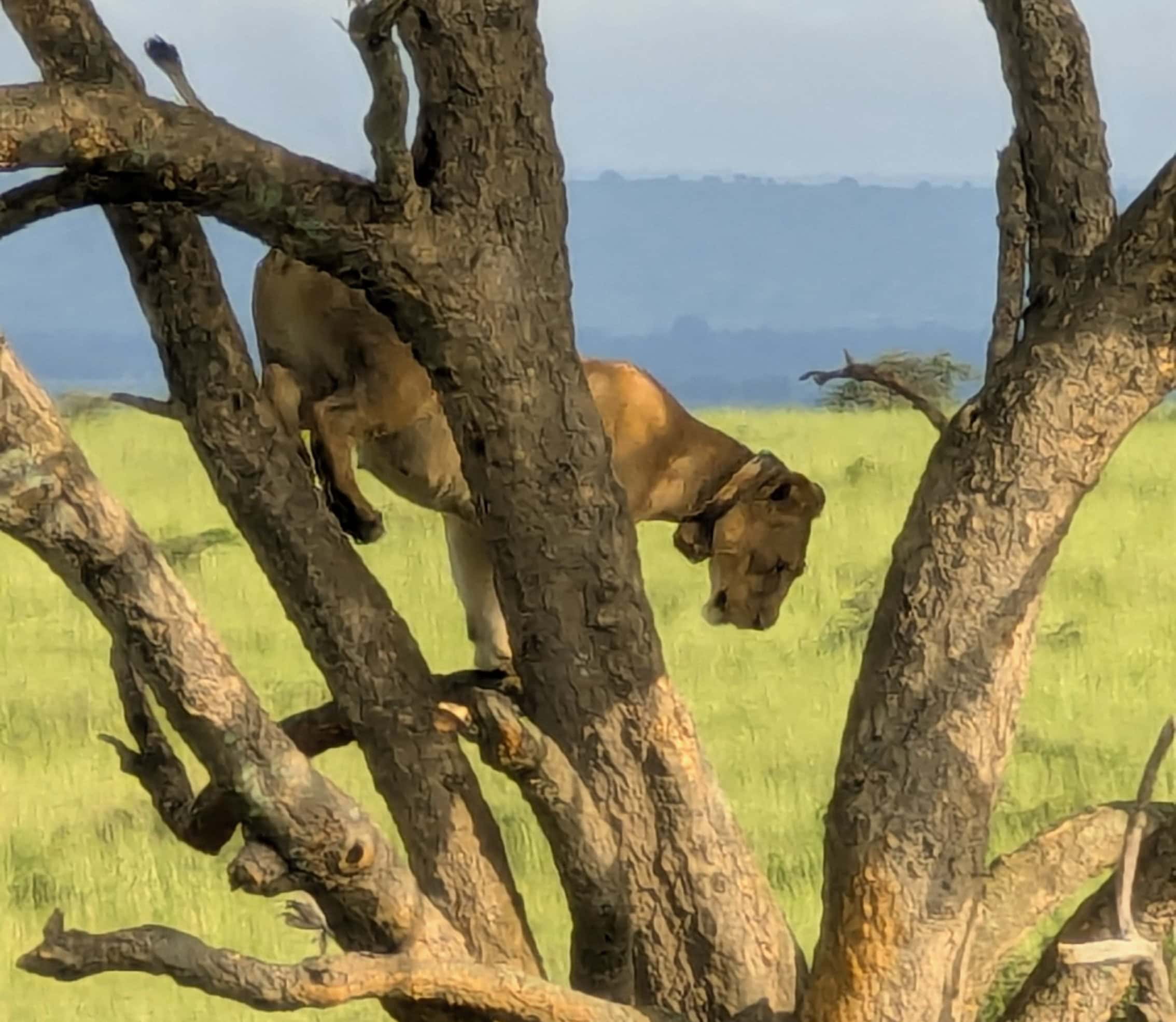
Here, lions are famous for resting in the branches of large fig trees. Seeing a lion above the ground is never guaranteed, but when conditions align, it creates one of Uganda’s most distinctive wildlife photographs.
We usually recommend spending enough time in the sector rather than treating Ishasha as a quick stop.
Ishasha is famous for its tree-climbing lions, which sometimes rest on large fig trees during the heat of the day. The behaviour is particularly associated with the southern sector of Queen Elizabeth National Park, although sightings are never guaranteed.
Ishasha also supports elephants, buffaloes, hippos, topi and other savanna species. Its remote character gives the area a different atmosphere from the busier central sections of the park.
For travellers continuing toward Bwindi Impenetrable National Park, Ishasha can be strategically positioned within a western Uganda itinerary.
Ishasha is not only about tree-climbing lions.
We recommend it because:
UWA specifically highlights Ishasha for classic game viewing and its tree-climbing lions.
The Kazinga Channel boat cruise is one of the experiences we most strongly recommend in Queen Elizabeth National Park.
The channel connects Lake George and Lake Edward, creating an important aquatic habitat where wildlife gathers around the water.
From the boat, you can often see:
The perspective is completely different from a game drive.
Instead of looking across the savanna from a vehicle, you move slowly along the water while wildlife gathers along the shoreline.
For photographers, the cruise can be especially rewarding because it provides low-angle views of animals near the water.
UWA’s park information identifies Mweya as the main tourism hub and the Kazinga Channel as a major attraction, with boat trips operating from the area.
The standard launch experience is generally planned as a roughly two-hour activity, although exact operating arrangements can vary.
We recommend checking the latest operating schedule when booking because activity arrangements and UWA procedures can change.
Queen Elizabeth National Park is not only a Big Game destination.
You can also track chimpanzees in Kyambura Gorge, a dramatic forested valley carved into the savanna landscape.
The experience involves walking through the gorge with trained guides while searching for chimpanzees and other forest species.
Chimpanzees are wild animals, so sightings cannot be guaranteed.
That is part of what makes the experience meaningful.
You enter their habitat and follow signs such as calls, movement, feeding activity and tracks while your guides interpret the forest around you.
UWA confirms that chimpanzee tracking and habituation activities take place in Queen Elizabeth and notes that chimpanzee movements can vary seasonally.
If chimpanzees are the main reason for your Uganda trip, we generally recommend Kibale Forest National Park.
If you want a broader safari that combines wildlife with a chimpanzee experience, Kyambura Gorge can be an excellent addition to Queen Elizabeth National Park.
We can help you choose based on your priorities, available time and budget.
Queen Elizabeth National Park is one of Uganda’s premier birding destinations.
The park’s remarkable bird diversity comes from its mixture of savanna, woodland, forest, wetlands, lakes and riverine habitats. UWA records more than 600 bird species.
Birders may encounter species such as:
The park is also important because it sits at an ecological meeting point between East African savanna and Congo-influenced forest habitats.
That geographic position contributes to its exceptional bird diversity.
Migratory birds are generally present from November to April, according to UWA’s environmental documentation.
For serious birders, we can build a dedicated birding itinerary rather than treating birdwatching as an incidental activity.
Queen Elizabeth National Park is much more than open grassland.
Its scenery changes dramatically as you move through different areas.
You can encounter:
The Kasenyi Plains provide classic safari scenery, with open grasslands supporting Uganda kob, buffaloes, lions and other wildlife.
Lake George, Lake Edward and the Kazinga Channel form a major part of the park’s ecological identity.
Kyambura Gorge and Maramagambo Forest introduce a greener, more enclosed environment where primates and forest birds become important.
The Katwe Explosion Craters reveal the area’s volcanic and geological history.
On clear days, the dramatic Rwenzori Mountains create an unforgettable background beyond the park.
The Katwe Explosion Craters are among Queen Elizabeth National Park’s most striking geological attractions.
The crater landscape reflects the volcanic history of the Albertine Rift.
We recommend adding the crater drive when you want a break from conventional wildlife viewing.
The route provides opportunities for:
The UWA park guide identifies a crater drive between the Kabatoro and Crater gates and describes the area as a landscape shaped by extinct volcanic craters.
A Queen Elizabeth safari can be much more varied than a standard game-drive itinerary.
Game drives remain the core safari experience.
We normally plan drives around wildlife activity, seasonal conditions and your interests.
Morning drives can be productive because temperatures are cooler and many animals are active.
Afternoon drives can create different photographic opportunities as the light changes.
Night drives, where available and permitted, offer another perspective on the park’s wildlife.
UWA’s current activity information lists day and night game-drive options among the activities available in Queen Elizabeth National Park.
The cruise is one of the park’s signature experiences.
It is particularly worthwhile for travellers interested in hippos, elephants, buffaloes, crocodiles and waterbirds.
Explore Kyambura Gorge with trained guides while searching for chimpanzees and forest wildlife.
The Kasenyi Plains and Ishasha provide opportunities to search for lions and other predators.
For travellers interested in predator behaviour, specialised experiences may also be available through UWA’s activity framework.
With more than 600 recorded bird species, Queen Elizabeth rewards both casual birdwatchers and dedicated birders.
The crater landscapes provide a scenic and geological dimension to your safari.
Communities surrounding the park provide opportunities to learn about local livelihoods, fishing traditions, crafts, music, dance and the relationship between people and wildlife.
Understanding the park’s different sectors can help you plan a better safari.
| Sector | Best Known For | Ideal For |
| Mweya | Kazinga Channel, central park access | First-time visitors |
| Kasenyi Plains | Uganda kob, lions, savanna | Game drives |
| Ishasha | Tree-climbing lions, remote scenery | Wildlife + Bwindi itineraries |
| Kyambura | Chimpanzee tracking | Primate lovers |
| Maramagambo | Forest and birdlife | Nature and birding |
| Katwe | Explosion craters | Scenic drives |
Rather than choosing a sector based only on its reputation, we consider your entire itinerary.
For example, we may recommend Ishasha if you are travelling onward to Bwindi. For a shorter safari, Mweya and Kasenyi can make more logistical sense.
Travelers planning a Uganda adventure often wonder how to make the most of their journey by combining Queen Elizabeth National Park with gorilla trekking and chimpanzee tracking. Fortunately, the park’s convenient location makes this seamless. After exploring Queen Elizabeth’s iconic tree-climbing lions, Kasenyi Plains’ vibrant wildlife scenes, and unforgettable boat safaris along the Kazinga Channel, visitors can easily continue their safari circuit.
These connected journeys create a well-rounded safari holiday, blending classic savanna game drives, gorilla trekking, and primate tracking. Transport between parks is straightforward, whether by road or air, offering flexibility to design an itinerary that fits every family’s pace and interests. Pairing these top destinations ensures that each wildlife encounter is more rewarding, immersive, and unforgettable.
Queen Elizabeth National Park is open for tourism throughout the year, but the drier periods are generally preferred for easier game viewing and road conditions. The wetter seasons can be rewarding for birding, greener landscapes and some chimpanzee activity, although rain can make some tracks muddy.
June to September
These months are generally popular for safari travel because rainfall tends to be lower.
Wildlife often becomes easier to locate around water and open areas.
December to February
This period is another favourable window for wildlife-focused safaris.
Conditions are often relatively dry, although weather patterns vary.
March to May
The long rains can produce lush landscapes and fewer visitors.
For photographers and birders, green-season conditions can be attractive.
October to November
Short rains can bring fresh vegetation and excellent scenery.
Migratory birds also begin becoming relevant later in the year.
Our recommendation
We do not believe there is one universally perfect month.
Instead, we match the season to your priorities.
If your priority is classic game viewing, we generally favour the drier periods.
If your priority is birding, green landscapes, photography or fewer visitors, wetter periods can offer a different and rewarding experience.
UWA confirms that Queen Elizabeth National Park can be visited year-round.
Queen Elizabeth has a generally moderate climate compared with many lower-elevation East African safari destinations.
UWA’s park information gives typical daytime temperatures of approximately 18°C to 28°C, although conditions vary by location, altitude and season.
Rain can occur even during traditionally drier periods.
For that reason, we recommend packing:
Queen Elizabeth National Park is approximately 410 kilometres from Kampala by road, according to UWA.
By road
Most travellers visit Queen Elizabeth as part of a western Uganda safari.
The journey can take approximately 7–8 hours or longer, depending on your starting point, route, stops and road conditions.
We rarely recommend treating the drive as simply a transfer.
Instead, we can build interesting stops into your itinerary.
Depending on your route, you can combine Queen Elizabeth with:
By air
Domestic and chartered flights can also reduce travel time.
UWA identifies nearby air access points including Kasese, Mweya and Kihihi, depending on which part of the park and itinerary you are visiting.
For luxury travellers with limited time, flying can transform the pace of a Uganda safari.

Queen Elizabeth National Park offers accommodation across different price categories, from budget and mid-range properties to luxury safari lodges and tented camps.
We select accommodation based on:
Mweya area
Mweya is the park’s primary tourism hub and provides convenient access to the Kazinga Channel and central wildlife areas. UWA identifies accommodation and visitor facilities around the Mweya Peninsula.
Ishasha area
Staying in Ishasha makes sense for travellers who want more time in the southern sector and those continuing toward Bwindi.
Kyambura area
This area works particularly well for travellers combining wildlife viewing with chimpanzee tracking.
We do not recommend choosing a lodge solely because it has the highest online rating. Location can have a major effect on the amount of time you spend on safari.
The cost of a Queen Elizabeth National Park safari depends on several factors.
Your total price can include:
For current UWA-listed fees, the official system currently shows US$40 for a foreign non-resident adult park entrance, US$30 for a foreign resident adult, and UGX 20,000 for East African Community residents. The listed activity fees include US$30 for the boat cruise, US$30 for a day game drive, and US$50 for chimpanzee tracking for foreign non-residents.
Because UWA updates tariff schedules, we recommend confirming the applicable rates for your travel date before making payment. UWA currently publishes tariff information and a 2026–2027 tariff update on its official rates page.
Most travelers wonder if they should explore independently or book a guided Tour. A trusted operator like Lavish Safaris Uganda ensures smooth logistics, reliable vehicles, and knowledgeable guides who understand wildlife behavior. Guides offer insights during Walking Safaris, Game Drives, and Hiking tours that travelers rarely gain alone. Professional planning also helps families choosing Family Safaris or luxury travelers seeking premium comfort. Booking with experts ensures timely connections, secure payments, and well-organized itineraries that maximize sightings of wildlife, especially tree-climbing lions.
Queen Elizabeth National Park is renowned for its rich biodiversity, boasting over 610 bird species—more than the entire British Isles! The park’s famed tree-climbing lions often steal the show, but visitors can also encounter elephants, hippos, crocodiles, buffalo, and a variety of antelope roaming the savannah.
Professional safari companies help you experience the park’s full spectrum of activities. Beyond the classic game drives, you can enjoy a boat cruise along the Kazinga Channel—a must for up-close views of bathing hippos and sunning crocodiles, as well as prolific birdlife along the banks. Adventurous travelers may explore the Kyambura Gorge, a lush ribbon of forest that’s home to chimpanzees and other primates. Guided chimp tracking is offered twice daily, providing a unique contrast to the open savannah expeditions.
Expert guides not only interpret the sights and sounds of the wild, but also tailor your experience—whether you’re a birding enthusiast, a family seeking comfort and safety, or a couple drawn to secluded tented camps. With options ranging from family-friendly lodges to luxury accommodations, a professional safari company makes it easy to combine Queen Elizabeth National Park with bucket-list experiences like gorilla trekking in Bwindi Impenetrable Forest or chimpanzee tracking in Kibale Forest.
By choosing an experienced operator, you unlock the park’s true diversity—game drives, guided walks, boat cruises, and primate adventures—while enjoying seamless planning and local expertise every step of the way.
We price every safari individually rather than publishing one misleading figure.
A private safari can be tailored around:
Budget → Mid-range → Luxury → Ultra-luxury
Tell us your preferred travel dates, number of travellers and accommodation level, and we will prepare a transparent quotation.
Request a Queen Elizabeth Safari Quote
Both destinations offer excellent Ugandan wildlife safaris, but they provide different experiences.
| Queen Elizabeth | Murchison Falls |
| Famous Kazinga Channel | Famous Murchison Falls |
| 1,978 km² | Larger protected landscape |
| Strong primate component | Strong savanna wildlife |
| Ishasha tree-climbing lions | Nile River experiences |
| Rwenzori backdrop | Victoria Nile |
| Excellent birding | Excellent birding |
| Convenient for western Uganda | Ideal for northern Uganda circuits |
Choose Queen Elizabeth if you want wildlife, Kazinga Channel, chimpanzees, Ishasha and easy combination with Bwindi or Kibale.
Choose Murchison Falls if you want the Nile, the dramatic waterfall, broad savanna landscapes and a northern Uganda safari.
If you have enough time, visiting both creates a much more comprehensive Uganda safari.
One of the strongest Uganda safari combinations is Queen Elizabeth National Park + Bwindi Impenetrable National Park.
The two destinations complement each other beautifully.
You can begin with classic savanna wildlife before entering the ancient rainforest for mountain gorilla trekking.
A typical journey might include:
Entebbe → Queen Elizabeth → Ishasha → Bwindi → Lake Bunyonyi → Entebbe
Alternatively, we can combine Queen Elizabeth with Kibale for a broader primate-focused safari.
For honeymooners and luxury travellers, we can build a slower itinerary with premium lodges, private game drives and carefully selected experiences.
Queen Elizabeth can work very well for a family safari when the itinerary is designed around the children’s ages and interests.
We recommend balancing game drives with shorter activities rather than spending every day inside a vehicle.
Children can enjoy:
For younger children, we carefully consider drive times and accommodation arrangements.
For older children and teenagers, we can introduce more wildlife interpretation, photography and nature experiences.
A Uganda honeymoon does not need to be only about gorillas.
Queen Elizabeth adds the romance of open landscapes, private game drives, sunset views and intimate lodge experiences.
We can arrange a honeymoon itinerary featuring:
For couples, we focus on pace as much as luxury.
A beautiful lodge is not enough if you spend most of your honeymoon rushing between destinations.
A safari in Queen Elizabeth National Park contributes to a wider conservation and community landscape.
Uganda Wildlife Authority manages Queen Elizabeth National Park as part of its national protected-area system and works with communities around wildlife conservation and tourism.
UWA’s conservation approach includes community participation, revenue sharing, wildlife management and conservation education.
This relationship matters because the communities surrounding protected areas live alongside wildlife.
Tourism can help create economic incentives for conservation while supporting local livelihoods.
We encourage our guests to travel responsibly by:
We believe responsible travel should be part of the safari itself, not an afterthought.
When visiting Queen Elizabeth, we ask guests to remember that wildlife sightings are privileges, not performances.
We never encourage drivers to crowd animals simply to obtain a photograph.
We also respect park regulations, ranger instructions and designated routes.
The Uganda Wildlife Act and UWA regulations provide the framework for wildlife conservation and sustainable use in Uganda.
Our role is to give you an extraordinary experience while respecting the ecosystem that makes that experience possible.
We recommend 2–3 nights for most first-time visitors.
Suitable for travellers with very limited time.
You can include:
Our preferred option for a first visit.
It allows more flexibility for:
Ideal if you want a slower safari.
You can explore central Queen Elizabeth before moving toward Ishasha or another destination.
Longer Safari
For a deeper Uganda experience, we can combine Queen Elizabeth with:
Kibale + Queen Elizabeth + Bwindi or Murchison Falls + Kibale + Queen Elizabeth + Bwindi
We recommend booking your Uganda safari several months ahead, especially for peak travel periods.
Advance planning becomes particularly important when your itinerary includes:
The earlier we know your travel dates, the more accommodation choices we can work with.
However, last-minute Uganda safaris are sometimes possible depending on lodge and activity availability.
We are a Uganda-based safari company, and we design trips around how Uganda actually travels rather than selling a standard itinerary to every guest.
When you book with us, we focus on:
We can arrange private 4WD safari vehicles so your schedule remains flexible.
Our guides understand the routes, seasons, wildlife behaviour and practical realities of travelling through Uganda.
We build your safari around your interests rather than forcing you into a fixed package.
We can combine Queen Elizabeth with carefully selected luxury lodges and premium experiences.
We explain what your safari includes before you travel.
We encourage wildlife-friendly practices and responsible interaction with local communities.
Most importantly, we do not promise what nature cannot guarantee.
But wildlife remains wild.
That unpredictability is part of the reason we love Uganda.
Guests consistently highlight a handful of standout experiences during their visits to Queen Elizabeth National Park. Many recall the thrill of spotting vibrant birds, over 600 species flutter among the papyrus and fig trees, delighting beginners and seasoned birders alike.
Evenings on the Kazinga Channel bring memorable sunset boat cruises, where travelers relax and watch hippos, elephants, and buffalo gather along the shimmering banks.
Walking safaris offer a slower-paced adventure. Exploring on foot with expert guides, visitors describe an unmatched sense of connection with the landscape and its resident wildlife, from browsing antelope to elusive tree-climbing lions.
Of course, classic game drives remain a favorite for families and solo explorers. Each journey across the open savannah brings a new surprise—lions, leopards, or even playful warthogs. These authentic moments are the highlight of many safaris, capturing the wild, untamed magic that defines Queen Elizabeth National Park.
Yes. Queen Elizabeth National Park is worth visiting for travellers seeking diverse wildlife, savanna game drives, the Kazinga Channel, chimpanzee tracking, birding and dramatic landscapes. Its location also makes it one of Uganda’s most convenient parks to combine with Kibale and Bwindi.
The park is famous for its diverse wildlife, Kazinga Channel boat cruises, tree-climbing lions in Ishasha, Uganda kob, chimpanzee tracking in Kyambura Gorge, crater landscapes and exceptional birdlife.
Yes. Lions occur in Queen Elizabeth National Park, particularly around the Kasenyi Plains and Ishasha sector. However, wildlife sightings are never guaranteed.
Yes. Ishasha is particularly famous for lions that sometimes rest in the branches of large fig trees.
Yes. African elephants are among the notable large mammals found in the park.
Yes. Leopards occur in the park, although they are generally more elusive than elephants, buffaloes or Uganda kob. UWA notes leopard sightings around areas including Mweya and the Channel Track.
Yes. Chimpanzee tracking takes place in Kyambura Gorge, although sightings cannot be guaranteed.
The current UWA online activity system lists the adult foreign non-resident park entrance fee at US$40. Other categories have different rates. Because tariffs can change, we recommend checking the applicable rate for your travel date.
The UWA online activity system currently lists the boat cruise at US$30 for foreign non-residents. Rates should be reconfirmed for your travel date.
The current UWA online activity listing shows US$50 for foreign non-residents for chimpanzee tracking.
The park can be visited year-round. The drier months are generally preferred for easier game viewing and road conditions, while wetter periods offer lush scenery and can be excellent for birding.
The park is approximately 410 kilometres from Kampala. The road journey can take around 7–8 hours or longer depending on the route and stops.
We recommend at least 2–3 days for a meaningful first visit. Add more time if you want chimpanzee tracking, Ishasha or a slower luxury safari.
Absolutely. Queen Elizabeth and Bwindi are one of the strongest combinations for a Uganda safari because they provide contrasting savanna and rainforest experiences.
Yes. More than 600 bird species have been recorded in the park, making it one of Uganda’s outstanding birding destinations.
Queen Elizabeth National Park is a managed protected area under Uganda Wildlife Authority. Visitors should follow ranger instructions, remain inside safari vehicles where required and respect wildlife regulations. We provide current practical travel guidance when planning your safari.
Most travelers wonder if they should explore independently or book a guided Tour. A trusted operator like Lavish Safaris Uganda ensures smooth logistics, reliable vehicles, and knowledgeable guides who understand wildlife behavior. Guides offer insights during Walking Safaris, Game Drives, and Hiking tours that travelers rarely gain alone. Professional planning also helps families choosing Family Safaris or luxury travelers seeking premium comfort. Booking with experts ensures timely connections, secure payments, and well-organized itineraries that maximize sightings of wildlife, especially tree-climbing lions.
If you’re ready for an unforgettable adventure, reaching out to a safari specialist helps streamline every detail—from selecting the best lodges and planning your daily routes to ensuring you don’t miss highlights like the famous tree-climbing lions of Ishasha. With expert help, you can customize your safari to suit your interests, comfort level, and schedule, making the most of every moment in Queen Elizabeth National Park. Whether you’re new to African safaris or a seasoned explorer, professional guidance helps transform your trip into a seamless, stress-free, and truly memorable experience.
Queen Elizabeth National Park brings together the experiences many travellers imagine when they picture an African safari: elephants crossing open grassland, lions watching Uganda kob, hippos gathered along the Kazinga Channel, birds moving through wetlands and the Rwenzori Mountains rising beyond the horizon.
Yet the park offers more than wildlife.
It offers crater landscapes, forests, chimpanzees, fishing communities, local cultures and the changing light of the Albertine Rift.
We can turn these experiences into a private Uganda safari designed around your interests, travel style and budget.
Whether you are planning a luxury Uganda safari, family holiday, honeymoon, wildlife photography trip, birding safari, chimpanzee adventure or gorilla trekking extension, we can create a route that fits.
Tell us your travel dates, number of travellers and preferred safari style. We will help you build your ideal Uganda itinerary.