

Bwindi Impenetrable Forest is Uganda’s premier destination for mountain gorilla trekking, offering intimate encounters with endangered gorillas inside an ancient rainforest. Located in southwestern Uganda, this UNESCO World Heritage Site also rewards travelers with exceptional birding, primate watching, forest walks, cultural experiences, dramatic mountain scenery, and luxury lodge stays. At Lavish Safaris Uganda, we create tailor-made Bwindi safaris around the trekking sector, accommodation, travel style, and wider Uganda itinerary that suit you best.
| Feature | Details |
| Location | Southwestern Uganda |
| Protected area | Bwindi Impenetrable National Park |
| UNESCO status | World Heritage Site since 1994 |
| Forest area | About 32,092 hectares |
| Altitude | Approximately 1,160–2,706 metres |
| Main attraction | Mountain gorilla trekking |
| Gorilla trekking sectors | Buhoma, Ruhija, Rushaga and Nkuringo |
| Other experiences | Birding, nature walks, cultural experiences and forest hikes |
| Best-known wildlife | Mountain gorillas, chimpanzees, monkeys, forest elephants and forest hogs |
| Birdlife | More than 347 recorded species |
| Gorilla trekking age | Minimum 15 years |
| Forest character | Ancient, mountainous tropical rainforest |
UNESCO describes Bwindi as a biodiversity hotspot where lowland and montane forests meet. The park supports exceptional numbers of trees, ferns, butterflies, birds and threatened wildlife. It also protects almost half of the world’s remaining mountain gorillas.

Bwindi stands apart because few African destinations combine endangered mountain gorillas, ancient rainforest, exceptional biodiversity and community tourism so closely.
The forest occupies the eastern edge of the Albertine Rift. Its varied elevations create several ecological zones within a relatively compact protected area. UNESCO records more than 200 tree species, around 104 fern species and 202 butterfly species. The park also supports many Albertine Rift endemics.
Yet numbers alone do not explain Bwindi’s appeal.
We believe the forest becomes most memorable when you experience it slowly.
You wake to mist rolling across forested hills, follow a ranger along a narrow trail, hear birds calling somewhere above the canopy. Then your trackers signal that a gorilla family is close.
Suddenly, the rainforest feels completely different.
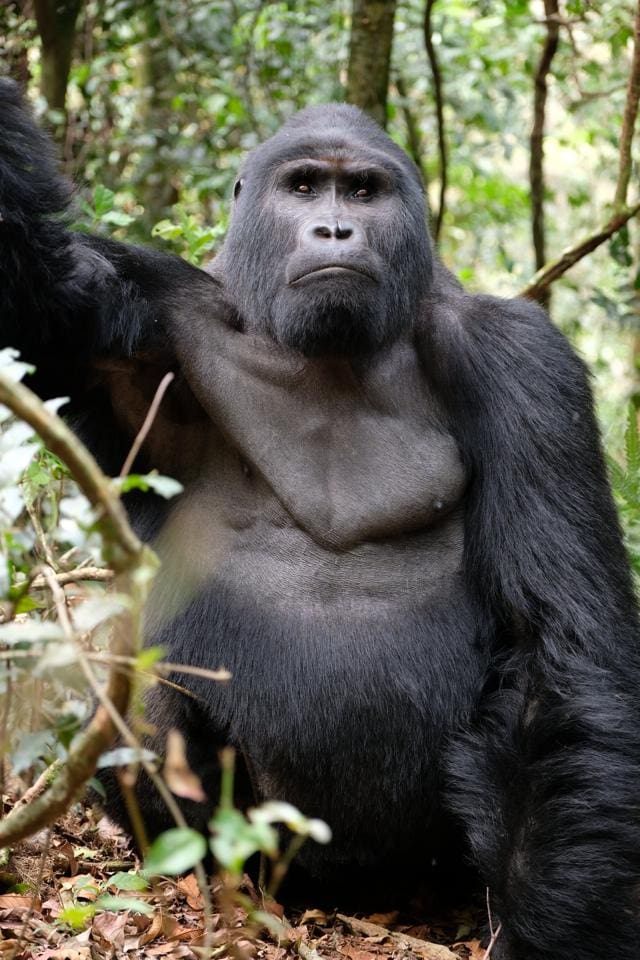
A silverback may appear through the vegetation. A mother may carry her infant nearby. Juveniles may climb, wrestle and investigate their surroundings.
For many travelers, that first quiet moment with a mountain gorilla becomes the defining memory of their Uganda safari.
Gorilla trekking is Bwindi’s signature experience. You enter the forest with trained guides and trackers to locate a habituated mountain gorilla family. Once you find the group, you normally spend one hour observing them under strict conservation guidelines.
The trek itself is part of the adventure.
There is no fixed route because gorillas move through the forest every day. Rangers and trackers establish their location before and during the trek, then guide visitors through the terrain.
Some treks are relatively short, Others require several hours of walking across steep slopes, thick vegetation and muddy trails.
That unpredictability makes Bwindi feel genuinely wild.
Your day usually begins early at the designated trailhead for your trekking sector.
You receive a briefing before entering the forest. Your ranger explains safety procedures, gorilla etiquette and what to expect.
You then walk into the forest.
Trackers may follow signs left by the gorillas, including vegetation damage, nests and other clues. The route changes depending on where the family spent the previous night.
When you locate the gorillas, your group spends the permitted viewing period observing them.
Your ranger helps you understand their behaviour while ensuring that visitors follow the required rules.
After the encounter, you walk back to the trailhead.
The return journey can feel surprisingly different. You may notice birds, butterflies, monkeys and plants that you overlooked while concentrating on finding gorillas.
Bwindi gorilla trekking can be physically demanding because the forest is mountainous, humid and often muddy. Trek difficulty varies significantly by gorilla family and location, so we recommend preparing for several hours of walking.
You do not need to be an elite hiker.
However, you should be comfortable walking for extended periods on uneven ground.
The terrain can include:
We recommend regular walking and hill training before your safari.
A walking stick can also make a major difference on steep or slippery sections.
Our local tip: If you have concerns about fitness, tell us before booking. We can help you choose a suitable trekking sector and arrange a porter to make the experience more manageable.
One of the most important decisions when planning a Bwindi gorilla safari is choosing your trekking sector.
Bwindi has four principal tourism sectors:
Each sector has different landscapes, accommodation options, access routes and trekking characteristics.
At Lavish Safaris Uganda, we do not treat all four sectors as interchangeable. We consider your itinerary, accommodation preference, fitness, arrival route and travel priorities before recommending where you should trek.
Buhoma is Bwindi’s historic northern trekking sector and one of the best choices for travelers who want established gorilla tourism infrastructure, rainforest walks and easy integration with Queen Elizabeth National Park. it has a long history of gorilla tourism.
It also offers a strong selection of accommodation and forest activities beyond gorilla trekking.
You can combine your gorilla experience with guided forest walks, birding and community activities.
The sector works particularly well for travelers arriving from Queen Elizabeth National Park.
A popular route connects Queen Elizabeth’s Ishasha area with southern Bwindi, although the exact journey depends on your itinerary and lodge.
Buhoma is also attractive for travelers who want to extend their stay rather than rush through the forest.
Ruhija offers a quieter Bwindi experience and is especially attractive to birdwatchers, nature enthusiasts and travelers who prefer a less developed forest setting. it lies in the eastern part of Bwindi.
Its elevation and forest habitats make it an excellent area for birding.
The sector is particularly interesting for travelers who want to combine gorilla trekking with broader rainforest exploration.
Ruhija also fits well into itineraries connecting Bwindi with Kibale, Queen Elizabeth and other western Uganda destinations.
If birding is an important part of your trip, tell us before we finalize your itinerary.
We can structure your schedule to allow more time for forest birding instead of treating Bwindi as a one-night gorilla stop.
Rushaga is one of Bwindi’s most versatile sectors, especially for travelers interested in gorilla trekking and the Gorilla Habituation Experience. It lies in southern Bwindi and works particularly well with Lake Bunyonyi and Rwanda itineraries.
Rushaga provides access to several habituated gorilla groups.
Its location also makes it an attractive choice for travelers approaching Bwindi from Kisoro or Rwanda.
The major distinction is the availability of the Gorilla Habituation Experience.
This specialist experience allows substantially more time observing a gorilla group than standard trekking.
For travelers who want a deeper understanding of gorilla behaviour and conservation, Rushaga deserves serious consideration.
Nkuringo is ideal for travelers who value dramatic scenery, intimate lodge experiences and a more adventurous trekking atmosphere. The sector overlooks spectacular landscapes toward the Virunga volcanic region.
Nkuringo sits in southern Bwindi at a high elevation.
The surrounding hills create some of the most memorable views in the region.
The sector works beautifully for luxury travelers and honeymooners who want a romantic rainforest setting.
It can also be combined with longer forest walks, including routes connecting the southern and northern sides of Bwindi.
Because terrain and gorilla movements vary, we recommend discussing your fitness level before choosing Nkuringo purely for its scenery.
| Sector | Best For | Main Advantage |
| Buhoma | First-time visitors | Established tourism infrastructure |
| Ruhija | Birdwatchers | Excellent Albertine Rift birding |
| Rushaga | Gorilla enthusiasts | Gorilla trekking and habituation |
| Nkuringo | Luxury and adventure travelers | Mountain scenery and dramatic setting |
There is no universally best Bwindi sector, The best sector is the one that fits your safari.
A honeymoon couple may prioritize a romantic lodge and spectacular views. A birder may prefer Ruhija. A traveler arriving from Queen Elizabeth may find Buhoma more convenient. Someone seeking the longest gorilla encounter may prefer Rushaga.
That is why we plan Bwindi around the traveler rather than selling the same itinerary to everyone.
The Gorilla Habituation Experience is designed for travelers who want more time with gorillas than a standard trek provides. It takes place in southern Bwindi and allows visitors to spend up to four hours with a gorilla group under the supervision of researchers, guides and trackers.
The experience offers a deeper look into gorilla behaviour.
Instead of simply finding a fully habituated family and observing it for the standard viewing period, participants follow a group undergoing habituation.
You may spend more time observing:
The experience costs more than standard gorilla trekking, so it suits travelers who place a high value on extended wildlife encounters.
For current permit prices, we recommend confirming rates with us when booking because Uganda Wildlife Authority tariffs can change.
The standard Uganda gorilla trekking permit has historically been USD 800 for foreign non-residents under the UWA tariff covering July 2024–June 2026. UWA also introduced discounted low-season rates in 2026, so we recommend checking the applicable rate for your exact trekking date before payment.
Permit prices depend on visitor category and travel date.
For the published 2024–2026 UWA tariff, the standard rates were:
| Visitor category | Gorilla tracking |
| Foreign Non-Resident | USD 800 |
| Foreign Resident | USD 700 |
| Rest of Africa | USD 500 |
| East African Citizen | UGX 300,000 |
The same UWA tariff listed Gorilla Habituation at USD 1,500 for foreign non-residents.
In 2026, UWA introduced discounted low-season gorilla tracking rates for April, May and November. The reported foreign non-resident rate is USD 600 during those promotional periods. These permits have specific booking conditions, including restrictions on rescheduling.
Because tariff periods and promotional rates can change, we recommend confirming the current rate before we secure your permit.
Your permit is not the total cost of a Bwindi safari.
A complete trip may also include:
We build these elements into your safari proposal so you can understand your total trip cost before confirming.
Uganda’s minimum age for gorilla tracking and viewing is 15 years. Uganda Wildlife Authority’s gorilla and chimpanzee tracking guidelines specify the minimum age requirement.
Families traveling with younger children can still enjoy Uganda.
We can design family itineraries featuring activities suitable for children, including wildlife viewing, cultural experiences and selected nature activities.
For families with teenagers aged 15 and above, gorilla trekking becomes an option subject to the applicable regulations and permit availability.
Bwindi is open for tourism throughout the year, but June to September and December to February are traditionally popular periods for trekking because they generally bring drier conditions. The rainforest climate means rain remains possible in every season.
This period is popular because trekking trails are often easier than during the wetter months.
It is a strong choice for first-time gorilla trekkers.
However, demand can also be higher.
These months provide another generally drier period.
They work particularly well for travelers combining Bwindi with other Uganda destinations.
The landscape becomes lush and green.
Rainfall can make trails more challenging, but photographers and travelers seeking quieter conditions may enjoy the atmosphere.
Shorter wet-season conditions can occur.
Again, rain does not mean you cannot trek.
Bwindi is rainforest, so weather can change quickly.
Our local tip: We always recommend carrying rain protection, even during traditionally dry months.
It is much more than a gorilla destination. Its ancient forest supports a remarkable range of primates, mammals, birds, butterflies, trees and ferns, including numerous Albertine Rift endemics.
The forest supports species such as:
However, rainforest wildlife behaves differently from savannah wildlife.
You should not expect the same visibility you get on a game drive in Queen Elizabeth or Murchison Falls.
Forest animals often remain concealed by vegetation.
That makes every sighting feel earned.
Bwindi ranks among Uganda’s most important forest birding destinations, with more than 347 recorded bird species and a strong concentration of Albertine Rift species. UNESCO identifies the forest as particularly important for montane forest birds and Albertine Rift endemics.
Serious birdwatchers can look for species associated with the Albertine Rift, including rare forest specialists.
Birding opportunities extend beyond a single morning walk.
We can arrange specialist birding activities around your gorilla trek.
This works especially well in Ruhija, although birding opportunities exist across the wider Bwindi ecosystem.
If birding is one of your primary interests, tell us when you make your inquiry.
We can allocate additional time instead of treating birding as an afterthought.
Bwindi offers guided forest walks for travelers who want to experience the rainforest without making gorilla trekking the sole focus of their visit.
Nature walks can reveal a different side of the park.
Instead of searching specifically for gorillas, you focus on the forest ecosystem.
Depending on the route, you may encounter:
UWA’s published tariff also includes guided nature walks and longer forest walking routes in Bwindi.
For active travelers, a longer forest walk can add another memorable dimension to a gorilla safari.
A Batwa cultural experience provides insight into the history, traditions and forest knowledge of communities with deep connections to the Bwindi landscape.
The Batwa are among the indigenous peoples historically associated with the forests of the Albertine Rift.
A responsible cultural visit should focus on genuine community engagement rather than staged entertainment.
Depending on the experience, you may learn about:
The UWA tariff also recognizes the Batwa Forest Experience as a tourism activity.
We encourage guests to choose community experiences that provide clear benefits to local people.
Bwindi is one of Africa’s most important conservation landscapes because it protects critical habitat for mountain gorillas and numerous other threatened and endemic species.
UNESCO considers the forest a conservation frontline because it sits within a heavily populated rural landscape.
The organization also notes that benefits from mountain gorilla and other ecotourism may be important to the future conservation of this exceptional forest.
This gives your safari a significance beyond tourism.
For us, responsible tourism is not a marketing phrase.
It is part of what makes a gorilla safari worth doing.
Bwindi offers accommodation ranging from comfortable lodges to high-end eco-luxury properties, with the best choice depending heavily on your trekking sector.
This point is important.
You should choose your lodge after confirming your gorilla trekking sector, not before.
A beautiful lodge in the wrong sector can create unnecessary driving on trekking morning.
Accommodation options around Bwindi commonly provide:
Luxury properties can make Bwindi particularly special for honeymooners.
Imagine returning from a demanding forest trek to a private cottage overlooking mist-covered hills.
That combination of adventure and comfort is one of our favorite ways to experience Uganda.
Most travelers reach Bwindi by road from Entebbe, Kampala or another Ugandan safari destination, while domestic flights can significantly shorten the journey to airstrips serving different parts of the region.
The best route depends on your trekking sector.
Road travel allows you to see more of Uganda’s countryside.
You can combine the journey with destinations such as:
Road travel takes longer, but it can become part of the safari rather than simply transportation.
Flying is particularly attractive for luxury travelers with limited time.
Flights can serve airstrips such as Kihihi or Kisoro depending on the itinerary and operating schedule.
The final transfer still requires road transportation.
We coordinate these connections around your gorilla trekking sector and lodge.
Bwindi can also be incorporated into a Rwanda-Uganda itinerary, making it possible to combine gorilla trekking with Kigali, Rwanda’s Volcanoes National Park, Lake Bunyonyi or other destinations.
This option works particularly well for travelers flying into Kigali.
Crossing into Uganda by road can provide a practical route to southern Bwindi.
Rushaga and Nkuringo can be especially relevant depending on the border crossing, itinerary and lodge selected.
For travelers who want to compare Uganda and Rwanda gorilla trekking, we can explain the differences in permits, landscapes, trekking sectors, accommodation and overall safari costs before you choose.
Bwindi combines naturally with Queen Elizabeth National Park for travelers who want both mountain gorillas and classic African wildlife in one Uganda safari.
This combination gives you two completely different ecosystems.
In Bwindi, you walk through mountainous rainforest.
In Queen Elizabeth, you explore savannah, wetlands, crater landscapes and the Kazinga Channel.
A safari can therefore combine:
Gorilla trekking + game drives + boat safari + forest experiences.
You may encounter elephants, lions, buffaloes, hippos, leopards and numerous antelope species during the Queen Elizabeth portion of your trip.
The exact wildlife sightings can never be guaranteed.
That unpredictability is part of the appeal of a real safari.
Combining Bwindi with Kibale creates one of Uganda’s strongest primate-focused itineraries, allowing you to experience mountain gorillas and chimpanzees during the same journey.
Kibale is famous for chimpanzee trekking.
Bwindi is famous for mountain gorillas.
Together, they create an exceptional great-ape safari.
We can also incorporate Queen Elizabeth between the two forests, creating a broader itinerary with primates and savannah wildlife.
For travelers interested in photography, conservation or primatology, this combination deserves serious consideration.
Lake Bunyonyi is an excellent relaxation stop before or after gorilla trekking, especially for travelers who want scenic landscapes, canoeing and slower-paced time in southwestern Uganda.
The lake’s rolling hills and numerous islands create a peaceful contrast to the physical intensity of gorilla trekking.
A stay here can help you recover after a demanding forest trek.
It also works beautifully for honeymoon itineraries.
We can combine:
Bwindi gorilla trekking + Lake Bunyonyi relaxation + cultural experiences.
This creates a balanced journey rather than filling every day with demanding activities.
Bwindi is one of Uganda’s most memorable honeymoon destinations because it combines a once-in-a-lifetime gorilla encounter with secluded rainforest lodges, dramatic scenery and romantic experiences.
A honeymoon in Bwindi does not need to feel rushed.
We can arrange a slower itinerary with:
The contrast is what makes it special.
You begin the morning walking through ancient rainforest.
You spend the day meeting mountain gorillas.
Then you return to a quiet lodge where the forest stretches beneath you.
That is the kind of honeymoon experience we love creating.
Pack for wet, muddy and changeable rainforest conditions. Good hiking footwear, waterproof clothing, long trousers, gloves and insect protection are among the most useful items.
Our recommended packing list includes:
Avoid bringing excessive luggage into the forest.
A small daypack is enough for most trekkers.
We strongly recommend considering a porter, even if you are physically fit. Porters can assist with bags, provide support on difficult terrain and create a direct economic benefit for people living around the park.
A porter can help you navigate:
You also free yourself to concentrate on the forest.
For many guests, hiring a porter becomes one of the most meaningful parts of the trek.
You receive practical assistance.
A local community member receives income.
That is a simple example of tourism creating tangible benefits.
Gorilla trekking rules protect both visitors and gorillas. The most important principles include respecting the required distance, following ranger instructions, avoiding trekking when sick and never attempting to touch or feed gorillas.
Uganda’s official guidelines specify a minimum trekking age of 15 years.
During your briefing, your ranger will explain the current rules in detail.
We ask our guests to follow them carefully.
Please remember:
The objective is simple.
We want today’s visitors to enjoy an experience that remains possible for future generations.
Bwindi is an established international tourism destination, and visitors trek with trained Uganda Wildlife Authority personnel. As with any wilderness experience, safety depends on following ranger instructions and preparing appropriately for forest conditions.
The gorilla trekking briefing is important.
So is appropriate clothing and footwear.
The forest is wild, and the terrain can be challenging.
We therefore plan your trip with practical considerations in mind.
We also monitor your itinerary, transfers and accommodation arrangements so you know what to expect throughout the journey.
We recommend at least two nights around Bwindi for a standard gorilla trekking experience. Three or more nights can create a more relaxed safari and allow time for cultural activities, forest walks or Lake Bunyonyi.
Best for travelers with limited time.
Usually includes:
Better for travelers who want breathing room.
You can include:
Ideal for slower luxury travel.
You can add:
We generally prefer three nights when the overall itinerary allows it.
You travel a long way to reach Bwindi.
It deserves more than a rushed overnight stop.
We can tailor Bwindi into almost any Uganda safari style.
A short, focused trip for travelers who want the gorilla experience without a long Uganda circuit.
Combines gorilla trekking with scenic relaxation.
Adds premium accommodation, private transfers and more relaxed pacing.
Combines Bwindi with Queen Elizabeth National Park.
Can combine Kibale, Queen Elizabeth and Bwindi.
Allows more time for Murchison Falls, Kibale, Queen Elizabeth and Bwindi.
We can also combine Uganda with Rwanda, Kenya or Tanzania when your broader East African itinerary calls for it.
We design Bwindi safaris around your priorities rather than offering a fixed itinerary that treats every traveler the same. Our local planning approach helps you select the right trekking sector, lodge, transport option and wider Uganda route.
When you travel with us, we can assist with:
Most importantly, we understand that your gorilla trek is not simply another activity.
It may be the reason you chose Uganda.
We therefore plan the rest of your safari around making that experience as smooth, comfortable and memorable as possible.

Bwindi Impenetrable Forest is one of those rare destinations where the journey feels as important as the destination itself.
Then, after hours of anticipation, you meet a mountain gorilla family in the wild.
The encounter may last only a limited time, but its impression can last forever.
Beyond gorillas, Bwindi rewards you with birds, butterflies, primates, forest trails, cultural encounters and spectacular scenery.
And because every trek unfolds differently, no two visitors experience exactly the same Bwindi.
Let Lavish Safaris Uganda design your private Bwindi gorilla safari around your preferred trekking sector, accommodation, travel dates and budget.
Contact us today to start planning your Bwindi Impenetrable Forest adventure.